St. Felix Catholic Church
St. Felix Church History
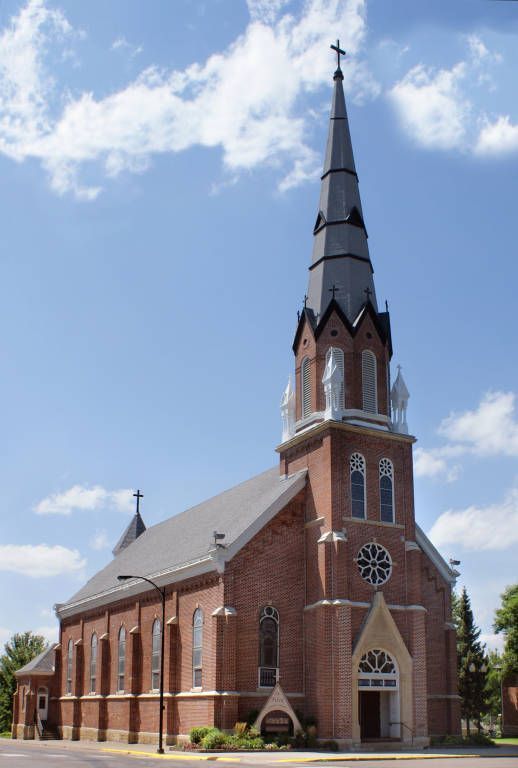
St. Felix was established in 1858. The present building was built in 1893 (seats 500).
St. Felix was named after Father Felix Tissot who was the first priest to serve the parish 1858- 1866.
Pipe Organ: It was installed in 1904 at the cost of $4,000.00. In 2000, the organ was refurbished at the cost of $50,000.00. Today, replacement would exceed $250,000.00
St. Felix School: Opened in 1872 by the School of Sisters of Notre Dame. Currently, the school has Pre-Kindergarten through 6th Grade. The High School closed and the last St. Felix High School Graduation class was 1968.
The Altars were imported from Bavaria, Germany in 1901. Hand-carved Butternut Wood.
FRONT ALTAR
St. Felix of Valois (1127-1212) His feast day is November 20th. (center top) St. Felix was born to a royal family. He gave up his good life to become a hermit and a priest. At seventy, he was called by God to found and run the Order of the Trinitarian. This religious group gave ransom to free Christian Slaves. St. Felix, with John of Mata, built monasteries and hospitals to care for the poor Christians. St. Felix has a vision of a white deer with a cross on the antlers. The Trinitarian Orders, therefore, wore a white habit with the red and blue cross on their chests.
St. Boniface (680-755) the patron Saint of Germany. (on the left) He was born in England. His dream was to convert Germany. Boniface is holding his bishop’s staff in his right hand and a book pierced by a dagger. Because books were rare and precious at this time, it is said that as a dagger came toward him, he lifted the book to protect it. This statue was chosen to represent the original German Parishioners of St. Felix Parish.
St. Patrick (385-461) is the patron saint of Ireland. (on the right) He was born in Great Britain and became a bishop and went to Ireland to preach the gospel. He used the three leaves of the shamrock to explain the Trinity (Father, Son, and Holy Spirit). This statue was chosen to represent the original Irish parishioners of St. Felix Church.
MARY ALTAR
Mary Patron of the Americas. Mary and her child Jesus are in the center. The rosary is a favorite prayer of the Catholic Church remembering Mary’s participation in the mysteries of salvation.
St. Agnes (277-300) Patron Saint for young girls. The statue on the left side of Mary. At age 12 she was arrested in Rome and ordered to deny God but refused and was beheaded. She is usually portrayed with a lamb and the sword of martyrdom.
St. Cecilia (2nd century) Patron Saint of Musicians. The statue is on the right side of Mary. She was persecuted in Rome because she had become a Christian. Note the musical instrument in her hand.
ST. JOSEPH ALTAR
St. Joseph Patron Saint of Carpenters and Foster Parents. St. Joseph is in the center. Respected for being the husband of Mary and loving stepfather of Jesus.
St. Aloysius (1568-1591) Patron Saint for Youth and Abused Children. Statue in white surplice. At a young age he began to devote his life to God. Even though his father did not want him to follow a religious vocation, entered the Society of Jesus when he was 17. He won a reputation for innocence and sanctity. Died at age 23.
St. John Berchmans (1599-1621) Is the Patron Saint for Altar Servers. Statue in the black cassock. Early in his life he wanted to become a priest. At age 17 he became a Jesuit novice and was known for his diligence and piety. He died at age 22. Many miracles were attributed to him after his death, and he was canonized in 1888.
Catholic history in Wabasha began over 170 years before St. Felix was formally incorporated as a Catholic parish in October 1858. Historians concur that as early as 1680 Father Louis Hennepin journeyed by canoe up the Mississippi River through the Wabasha area. The Holy Sacrifice of Mass was probably first offered in the Wabasha area as early as 1683 when Nicholas Perrot established a trading post at Wabasha; with Perrot at that time was the Jesuit, Father Joseph Jean Marest. In 1830 Augustine Rocque built the first house in Wabasha, at this house Mass was offered by Father Lucian Galtier. Father Galtier often stopped at this house on his travels between Mendota and Dubuque and offered Mass for the first settlers. In 1843 Father Galtier was transferred to Keokuk, Iowa. Father A. Ravoux who had been assisting him was left in exclusive charge of the Upper Mississippi River area.
In 1850 St. Paul was made an episcopal see with Rt. Rev. James Cretin, a personal friend of Father Ravoux, appointed as the first bishop. Bishop Cretin urged Father Ravoux to erect a chapel in Wabasha. Father Ravoux and Wabasha pioneers went to Chaska and rafted logs down the Minnesota and Mississippi Rivers to Wabasha where workers soon framed Wabasha’s first chapel on upper Main Street. The years after 1850 saw a considerable influx of settlers of Irish and German descent into Wabasha and Goodhue counties. The need for a resident pastor became imperative. Father Felix Tissot was appointed pastor of Catholics in Goodhue and Wabasha counties in 1858. Father Tissot immediately planned the building of a new church on land donated by Joseph Rocque at the site of the present St. Felix cemetery. When the church was completed, the Bishop decided not to dedicate the church because it was too far from the center of the city and insisted that the church be moved to a more central location. Father Tissot made plans to rebuild the church at the site of the former Notre Dame convent. The building was completed in 1862 and the dedication took place on July 27, 1862. The church was given the name of the pastor’s patron, St. Felix. Father Tissot also oversaw the establishment of the parish parochial school where he served as principal and teacher. When Father Tissot became pastor at St. Anthony parish in Minneapolis, he was succeeded in 1866 by Father James Trobec.
With the opening of the railroad in 1871 memberships of St. Felix was fast increasing. Father Trobec planned to build a new school and church. The first step in Father Trobec’s plan was the building of a new parsonage. When this was completed, the rooms on the ground floor of the church were remodeled for a residence for the nuns who were to conduct the new school. On September 1, 1874, the School Sisters of Notre Dame arrived to teach in the new school. The enrollment in 1872 was 71 pupils, half of whom were Indians. A new church was begun in 1874 and was dedicated by Bishop Grace on July 18, 1874.
In 1887 Father Trobec was asked to organize a new parish in St. Paul. His successor, a native of Germany, was Father Maxmillian Wurst. Father Wurst faced numerous difficulties, none as serious as the cry “the church is on fire.” That resounded throughout Wabasha on February 7, 1893. After the fire, Father Wurst began plans for a new church. On November 30, 1893, the new church was dedicated by Bishop Cotter. St. Felix had “risen from the ashes” and the church’s three bells, which had been recast after the fire, were reinstalled, and still serve today to summon the faithful. Father Wurst is credited with founding St. Elizabeth’s Hospital in 1898. On property that Father Wurst owned on the “west side” of Wabasha, the Sisters of the Sorrowful Mother established St. Elizabeth’s Hospital. With encouragement from Bishop Cotter and Father Wurst, in 1900 St. Joseph’s Orphanage was established. St. Felix’s need for a new parochial school was becoming apparent. In 1901 work was begun on a new school building. The school was completed in 1903. In 1904 a four-year high school curriculum was added. Father Wurst died in Wabasha in 1919. He was replaced by Father John Bartholome, a native of Wabasha County.
Father Bartholome, upon his arrival at St. Felix, was given the weighty responsibility of maintaining an established parish. His true worth as a priest, financier, and organizer is measured through his guidance of the parish through the difficult years of the Great Depression of 1930’s and through World War II. After the war there came an increased interest in education. The facilities of St. Felix School became crowded. Under Father Bartholome and Father William Anderson, the assistant pastor, plans were begun for a new high school and auditorium. On May 15, 1955, the new facility was blessed by Bishop Edward A. Fitzgerald. In 1956 after serving the church for 54 years as a parish priest, 37 of which were given as pastor of St. Felix Parish, Father Bartholome resigned his pastorate to live in retirement in Wabasha. His successor was Monsignor John A. Mich.
The successors to the pioneering pastors, who were such an influential force in the history of St. Felix and the whole Wabasha community, faced a series of new challenges. Vatican II caused the church to take a new look at the roles of both the clergy and laity in the life of the church. Economic and demographic changes caused the parish to make changes in how young people would be taught the tenets of the Catholic faith. This, combined with the decrease in vocations to the priesthood and religious life, would result in the closing of St. Felix High School in 1968. The pace and challenges of change have increased with the passing years. In the 1990’s for the first time in approximately 100 years, the parish had to do without an assistant pastor. In the past years, St. Felix entered a cluster arrangement with St. Agnes Church and the Church of the Immaculate Conception in Kellogg. Immaculate Conception is now combined with St. Joachim in Plainview, and St. Agnes remains clustered with St. Felix. The following priests have guided St. Felix through these challenges since 1964: Monsignor John P. Gengler, Father John P. Daly, Father Kenneth Schaum, Father Edgar J. Schaefer, Monsignor J. Richard Feiten, Father Gerald Conway, Father Donald Lovas, Father William Kulas, Father Glenn Frerichs, Monsignor Thomas Cook, Father Gregory Parrott, Father Prince Raja and Father Thomas Loomis.