
Welcome

Fr. Prince's Installation Mass, August 20, 2023 at St. Agnes.
Mass Times
Saturday 4:30 pm St. Felix, Wabasha
Sunday 8:00 am St. Agnes, Kellogg
Sunday 9:30 am St. Felix, Wabasha
Daily Mass
Tuesday 8:00 am St. Felix, Wabasha
Wednesday 8:00 am St. Agnes, Kellogg
Thursday 8:30 am (School In Session) St. Felix, Wabasha
Friday 8:00 am St. Felix, Wabasha
Reconcilation
Saturday 3:45pm St. Felix
Sunday 7:30am St. Agnes
For Reconcilation at other times, please contact Fr. Prince directly.
Office Hours
Friday 8:00 am-12:00 pm
Staff
- Heather Bergan, Administrative Assistant
- John Hust, Deacon
- Kathy Munns, Finance Office
- Michelle Gosse, Administrative Assistant
- Father Prince Raja, Pastor
- Position Open, Faith Formation Coordinator
Liturgical Schedule
Weekly Readings
Weekly reading
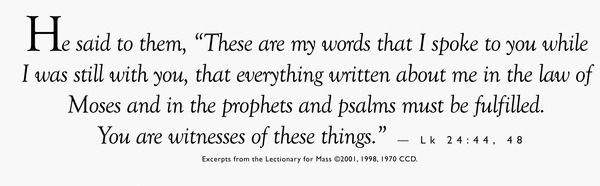

Readings for the week of April 14, 2024
- Sunday: Acts 3:13-15, 17-19 / Ps 4:2, 4, 7-8, 9 (7a) / 1 Jn 2:1-5a / Lk 24:35-48
- Monday: Acts 6:8-15 / Ps 119:23-24, 26-27, 29-30 / Jn 6:22-29
- Tuesday: Acts 7:51—8:1a / Ps 31:3cd-4, 6 and 7b and 8a, 17 and 21ab / Jn 6:30-35
- Wednesday: Acts 8:1b-8 / Ps 66:1-3a, 4-5, 6-7a / Jn 6:35-40
- Thursday: Acts 8:26-40 / Ps 66:8-9, 16-17, 20 / Jn 6:44-51
- Friday: Acts 9:1-20 / Ps 117:1bc, 2 / Jn 6:52-59
- Saturday: Acts 9:31-42 / Ps 116:12-13, 14-15, 16-17 / Jn 6:60-69
- Next Sunday: Acts 4:8-12 / Ps 118: 1, 8-9, 21-23, 26, 28, 29 (22) / Jn 3:1-2 / Jn 10:11-18
Becoming a member
Are you interested in joining St. Felix or St. Agnes as a parishoner? Please click on the link below to print and complete a census form. Please return the form to the parish office.
Online Giving
Catholic Charities

Diocese of Winona-Rochester

Courier

Word on Fire

Google Map
Social Media
A Facebook account is not required to view our Facebook page.

Click below to order Scrip and support St. Felix School.

2024 Catholic Ministries Appeal

Bishops Decree
Read the latest decrees from Bishop Quinn regarding the reinstatement of Sunday Mass obligation.
Charles I. Passe Endowment Fund
Announcing 2024–2025 Scholarship Program
Charles I. Passe Endowment Fund
The Catholic Foundation of Southern Minnesota has established a process for awarding endowment
funds. This 2024-2025 academic year, up to $47,900 is available for qualified students.
Funds from the Charles I. Passe Endowment Scholarship will be awarded in the following order:
1. St. Felix parishioners enrolled in a diploma and/or certificate program at a trade/technical
school
2. St. Felix parishioners enrolled in an Associate’s degree program at a trade/technical school
3. Cluster parishioners enrolled in a diploma and/or certificate program at a trade/technical school
4. Cluster parishioners enrolled in an Associate’s degree program at a trade/technical school
In the rare event that funds remain after all applications in those categories have been processed, the
Catholic Foundation of Southern Minnesota will consider other scholarship applications (i.e., Bachelor’s
degree programs). All awards are made by the Catholic Foundation of Southern Minnesota.
Applications will be available starting on February 5, 2024, at the St. Felix, St. Agnes, and Immaculate
Conception parish offices and websites, the Wabasha-Kellogg and Plainview-Elgin-Millville High School
counselor’s offices, and on the Catholic Foundation of Southern Minnesota website at
www.catholicfsmn.org/granting.
All applications must be returned to:
Catholic Foundation of Southern Minnesota
750 Terrace Heights, Suite 105
PO Box 30098
Winona, MN 55987
Applications must be received by 4:30pm on Friday, May 17, 2024. Notification of awards will be made
no later than July 1, 2024.
Please email Monica Herman at mherman@catholicfsmn.org or call 507-858-1276 with any questions.
Click HERE to download the application.
School
Bishop Andrew Cozzens, as Vicar of Catholic Education for the Archdiocese of St. Paul and Minneapolis, has an urgent request that he has asked us to share with every priest, parish, and school. You can watch his short video message here.
Right now legislators and Governor Walz have multiple proposals in front of them that can make real educational choices more accessible to parents and their children. Students, who urgently need access to schools that meet their unique educational needs, ask you and all people of good will to speak out now!
As a Catholic, your leadership on this issue is needed so that more people will take action.
Here are four things you can do to make an immediate impact:
- Send a message to your State Representative, Senator, and Governor Walz
- Encourage parents at your Catholic school to contact lawmakers
- Encourage your parishioners to speak out
- Use this template announcement for your bulletin or digital communications
- Share the action alert on your parish Facebook and Twitter
Find further resources here.
Thank you for taking the time to help bring better access to real educational opportunities to Minnesota kids.